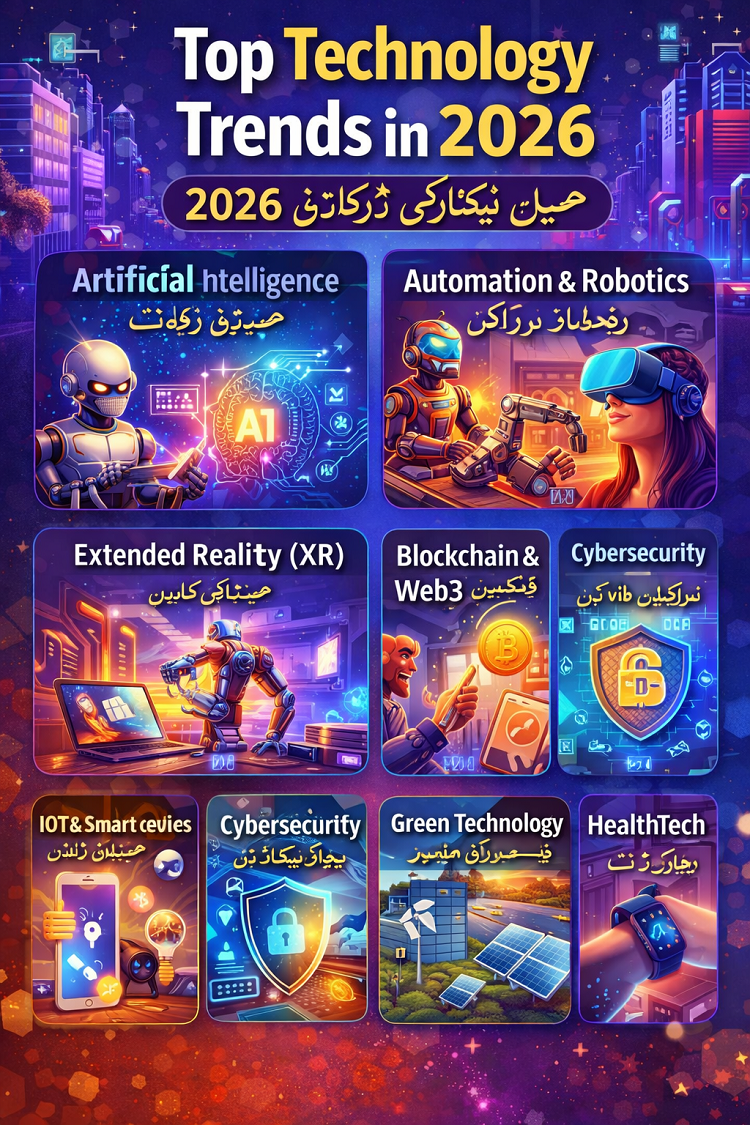
Top Technology Trends in 2026 Innovations Shaping the Future
Technology continues to evolve at a rapid pace, and 2026 marks a significant turning point in how digital innovations influence our daily lives, businesses, and global industries. From artificial intelligence to sustainable technology, the latest trends are not just improving efficiency but completely redefining how humans interact with machines and data.
In this article, we explore the top technology trends in 2026, explaining how they work, why they matter, and how they are shaping the future of work, communication, healthcare, and society as a whole.
Artificial Intelligence (AI) Becomes Smarter and More Human-Like
Artificial Intelligence remains the most dominant technology trend in 2026. AI systems are now more advanced, adaptive, and capable of performing complex tasks that previously required human intelligence.
Key Developments in AI
-
Advanced natural language processing
-
Real-time decision-making
-
Emotional and contextual understanding
-
AI-powered creativity (writing, images, videos, music)
AI is no longer limited to automation; it actively assists humans in problem-solving, innovation, and strategic planning.
Generative AI Growth
Generative AI tools can now:
-
Create realistic images and videos
-
Write articles, scripts, and code
-
Design marketing materials
-
Assist in education and research
In 2026, generative AI has become an essential tool for content creators, marketers, developers, and businesses.
Automation and Robotics Transform Industries
Automation combined with robotics is revolutionizing industries by increasing efficiency, reducing costs, and improving accuracy.
Industrial Automation
Manufacturing plants now rely on:
-
AI-powered robotic arms
-
Smart quality control systems
-
Predictive maintenance tools
These technologies reduce human error and improve production speed.
Service and Humanoid Robots
Robots are now being used in:
-
Hospitals and clinics
-
Hotels and restaurants
-
Warehouses and retail stores
In 2026, service robots assist humans rather than replace them, improving productivity and customer experience.
Extended Reality (XR): AR, VR, and MR Go Mainstream
Extended Reality (XR) includes Augmented Reality (AR), Virtual Reality (VR), and Mixed Reality (MR). These technologies are becoming more accessible and widely adopted.
Virtual Reality (VR)
VR is used for:
-
Training and simulations
-
Virtual meetings and collaboration
-
Education and e-learning
-
Gaming and entertainment
Improved hardware has made VR devices lighter, more affordable, and more realistic.
Augmented Reality (AR)
AR enhances real-world environments with digital elements. In 2026, AR is commonly used in:
-
Online shopping
-
Navigation and mapping
-
Industrial maintenance
-
Education
Mixed Reality (MR)
MR blends digital and physical worlds, enabling advanced simulations, product design, and interactive experiences.
Web3 and Blockchain Expansion
Web3 represents the next generation of the internet, focusing on decentralization, transparency, and user control.
Blockchain Beyond Cryptocurrency
Blockchain technology is now widely used for:
-
Secure digital identities
-
Supply chain tracking
-
Smart contracts
-
Digital ownership verification
These applications improve trust and security across industries.
Decentralized Finance (DeFi)
DeFi platforms offer financial services without traditional banks, including:
-
Peer-to-peer lending
-
Digital savings
-
Investment platforms
In 2026, DeFi continues to grow as users seek financial independence and transparency.
5G Connectivity and the Rise of 6G Research
High-speed internet is essential for modern technologies, and 2026 sees major progress in connectivity.
Global 5G Expansion
5G enables:
-
Ultra-fast internet speeds
-
Low-latency communication
-
Smart city infrastructure
-
Autonomous vehicles
6G Research Begins
Although still in development, 6G research promises:
-
Extremely high data speeds
-
Near-zero latency
-
Advanced AI-powered communication networks
Internet of Things (IoT) and Smart Ecosystems
The Internet of Things connects everyday devices to the internet, allowing them to collect and share data.
Smart Homes
In 2026, smart homes include:
-
AI-controlled lighting and appliances
-
Smart security systems
-
Energy-efficient solutions
These systems improve comfort, safety, and energy savings.
Smart Cities
IoT plays a crucial role in building smart cities by managing:
-
Traffic flow
-
Public transportation
-
Waste management
-
Energy distribution
Cybersecurity in the Age of AI
As technology advances, cyber threats become more sophisticated. Cybersecurity is a top priority in 2026.
AI-Powered Cybersecurity
AI systems now:
-
Detect threats in real time
-
Predict cyber attacks
-
Automatically respond to security breaches
Zero Trust Security Model
Organizations adopt a zero-trust approach, meaning:
-
Every user and device is continuously verified
-
Access is restricted based on identity and behavior
-
Internal and external threats are treated equally
Green Technology and Sustainable Innovation
Environmental concerns have accelerated the adoption of sustainable technologies.
Renewable Energy Advancements
2026 sees major progress in:
-
Solar energy efficiency
-
Wind power technology
-
Smart energy storage systems
Sustainable Technology Practices
Companies now focus on:
-
Reducing carbon footprints
-
Energy-efficient data centers
-
Environmentally friendly AI models
Green technology is no longer optional—it is a global priority.
HealthTech and Digital Healthcare
Technology is transforming healthcare by improving diagnosis, treatment, and patient care.
AI in Healthcare
AI assists doctors by:
-
Analyzing medical images
-
Predicting diseases early
-
Supporting drug discovery
Wearable Health Devices
Modern wearables track:
-
Heart rate and oxygen levels
-
Sleep patterns
-
Physical activity
-
Chronic health conditions
These devices promote preventive healthcare and personalized treatment.
Cloud Computing and Edge Computing Growth
Cloud technology remains the backbone of digital services.
Hybrid and Multi-Cloud Models
Businesses now use a mix of:
-
Public cloud services
-
Private cloud systems
-
On-premise infrastructure
This approach improves flexibility and security.
Edge Computing
Edge computing processes data closer to the source, which:
-
Reduces latency
-
Enables real-time processing
-
Supports IoT and autonomous systems
Low-Code and No-Code Development Platforms
Software development is becoming more accessible in 2026.
No-Code Tools
No-code platforms allow users to:
-
Build apps and websites
-
Automate workflows
-
Create digital products without programming skills
Business Benefits
-
Faster development cycles
-
Reduced development costs
-
Empowerment of non-technical users
Quantum Computing: The Future Frontier
Quantum computing is still emerging, but its impact is becoming visible.
Potential Applications
-
Complex problem-solving
-
Financial modeling
-
Drug discovery
-
Climate simulations
Quantum computing has the potential to redefine AI, cybersecurity, and scientific research in the future.
Conclusion: Why 2026 Is a Defining Year for Technology
The technology trends of 2026 represent more than just innovation—they reflect a shift toward smarter, more sustainable, and human-centered solutions. Artificial intelligence, automation, extended reality, blockchain, and green technology are shaping a future where technology enhances human potential rather than replacing it.
