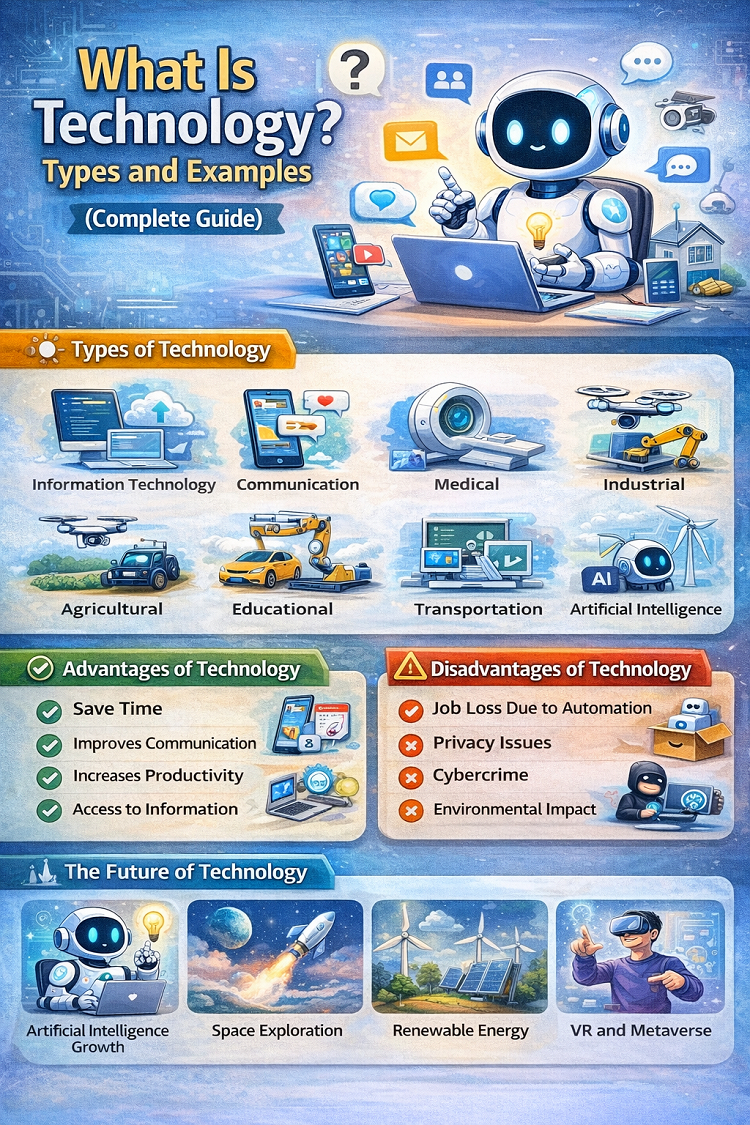
What Is Technology? Types and Examples (Complete Guide)
Technology is everywhere. From the smartphone in your pocket to the electricity powering your home, from online banking to artificial intelligence technology shapes the way we live, work, communicate, and learn. But what exactly is technology? How does it work? And what are its different types?
In this detailed guide, we will explore the meaning of technology, its history, major types, real-life examples, advantages, disadvantages, and its future impact on society.
What Is Technology?
Technology refers to the application of scientific knowledge, tools, techniques, and systems to solve problems and make human life easier, faster, and more efficient.
In simple words:
Technology is the use of tools and knowledge to solve problems.
It includes machines, devices, software, systems, and processes created by humans to improve daily life.
For example:
-
A smartphone is technology.
-
The internet is technology.
-
A washing machine is technology.
-
Artificial Intelligence is technology.
-
Even a simple wheel is technology.
Technology is not only about computers and electronics. It includes everything humans create to make tasks easier.
History of Technology
Technology has existed since ancient times.
1. Ancient Technology
Early humans created simple tools made of stone and wood. Examples include:
-
Stone tools for hunting
-
Fire for cooking
-
The wheel for transportation
-
Farming tools
These inventions helped humans survive and build civilizations.
2. Industrial Revolution
The Industrial Revolution (18th–19th century) introduced machines powered by steam and electricity. This changed production methods and created factories.
Important inventions:
-
Steam engine
-
Telegraph
-
Railways
-
Printing press improvements
3. Modern Technology Era
The 20th and 21st centuries introduced:
-
Computers
-
Internet
-
Smartphones
-
Artificial Intelligence
-
Robotics
-
Space exploration
Technology is now advancing faster than ever before.
Types of Technology
Technology can be divided into different categories based on its purpose and function.
1. Information Technology (IT)
Information Technology deals with computers, software, networks, and data management.
Examples:
-
Computers and laptops
-
Cloud storage
-
Websites
-
Software applications
-
Databases
-
Cybersecurity systems
IT allows businesses and individuals to store, process, and share information quickly.
2. Communication Technology
Communication technology helps people connect and share information instantly across the world.
Examples:
-
Smartphones
-
Social media platforms
-
Video conferencing (Zoom, Google Meet)
-
Email
-
Messaging apps
It has made global communication fast and easy.
3. Medical Technology
Medical technology improves healthcare and saves lives.
Examples:
-
MRI and CT scan machines
-
Vaccines
-
Robotic surgeries
-
Artificial organs
-
Telemedicine systems
Medical technology increases life expectancy and improves patient care.
4. Industrial and Manufacturing Technology
This type of technology is used in factories and production systems.
Examples:
-
Assembly lines
-
Robots in factories
-
3D printing
-
Automated machines
It increases productivity and reduces manual labor.
5. Agricultural Technology
Agricultural technology improves farming methods and food production.
Examples:
-
Tractors
-
Irrigation systems
-
Drones for crop monitoring
-
Genetically modified crops
It helps feed the growing global population.
6. Educational Technology (EdTech)
Educational technology improves teaching and learning experiences.
Examples:
-
Online learning platforms
-
Smart boards
-
Educational apps
-
Virtual classrooms
It makes education accessible to students worldwide.
7. Transportation Technology
Transportation technology makes travel faster and more efficient.
Examples:
-
Cars and electric vehicles
-
Airplanes
-
Bullet trains
-
GPS navigation systems
It connects cities, countries, and continents.
8. Artificial Intelligence and Automation
AI is one of the most advanced types of technology today.
Examples:
-
Chatbots
-
Self-driving cars
-
Facial recognition
-
Voice assistants (Alexa, Siri)
-
Machine learning algorithms
AI systems can learn from data and make decisions.
9. Energy Technology
Energy technology focuses on generating and storing power.
Examples:
-
Solar panels
-
Wind turbines
-
Nuclear power plants
-
Batteries
-
Electric grids
Renewable energy technology helps reduce pollution.
Real-Life Examples of Technology
Technology is part of daily life. Here are practical examples:
-
Online shopping websites
-
Mobile banking apps
-
Smart home devices
-
Fitness trackers
-
Streaming services like Netflix
-
GPS maps
-
Automated customer support
Without technology, modern society would function very differently.
Advantages of Technology
Technology offers many benefits.
1. Saves Time
Machines and automation complete tasks quickly.
2. Improves Communication
People can connect instantly across the world.
3. Increases Productivity
Businesses produce more goods and services efficiently.
4. Improves Healthcare
Advanced tools help diagnose and treat diseases.
5. Access to Information
The internet provides knowledge within seconds.
6. Economic Growth
Technology creates new industries and job opportunities.
Disadvantages of Technology
While technology offers many benefits, it also has challenges.
1. Job Loss Due to Automation
Machines can replace human workers in some industries.
2. Privacy Issues
Data collection can threaten personal privacy.
3. Cybercrime
Hacking and online fraud are growing concerns.
4. Addiction
Excessive use of smartphones and social media affects mental health.
5. Environmental Impact
Electronic waste and pollution harm the environment.
Importance of Technology in Modern Life
Technology is essential in today’s world.
-
Businesses depend on digital systems.
-
Education relies on online tools.
-
Healthcare uses advanced equipment.
-
Governments use digital data systems.
-
Communication happens through internet networks.
Technology is no longer optional — it is necessary.
The Future of Technology
The future of technology is exciting and transformative.
1. Artificial Intelligence Growth
AI will become smarter and more integrated into daily life.
2. Robotics Expansion
Robots will assist in homes, hospitals, and industries.
3. Space Exploration
Private companies and governments are exploring Mars and beyond.
4. Renewable Energy
Solar and wind power will replace fossil fuels gradually.
5. Virtual Reality and Metaverse
Digital environments may change how we work and socialize.
6. Biotechnology
Gene editing and personalized medicine will improve healthcare.
How Technology Impacts Society
Technology influences:
-
Culture
-
Economy
-
Education
-
Politics
-
Social relationships
It connects the world but also changes how people interact. Balancing innovation with responsibility is important.
Conclusion
Technology is the application of knowledge and tools to solve problems and improve human life. It has evolved from simple stone tools to advanced artificial intelligence systems.
There are many types of technology, including information technology, medical technology, communication technology, agricultural technology, transportation technology, and energy technology. Each plays a vital role in shaping modern society.
While technology brings convenience, productivity, and progress, it also presents challenges such as privacy concerns, job displacement, and environmental impact.
