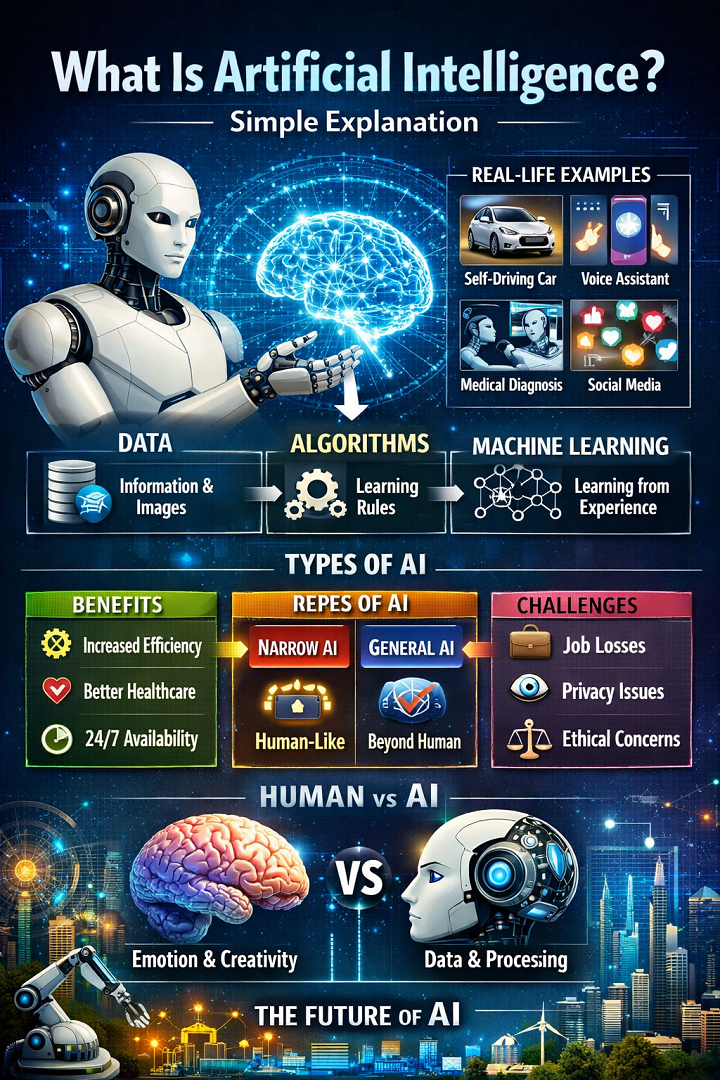
What Is Artificial Intelligence? Simple Explanation
Artificial Intelligence, often called AI, is one of the most talked-about technologies in the world today. From smartphones and social media to self-driving cars and medical research, AI is changing the way we live, work, and communicate. But what exactly is artificial intelligence? Is it robots taking over the world? Is it computers that think like humans? Or is it something much simpler?
In this article, we will explain what artificial intelligence is in simple terms, how it works, where it is used, its benefits and risks, and what the future might look like.
Understanding Artificial Intelligence in Simple Words
At its core, Artificial Intelligence is the ability of a machine or computer program to think, learn, and make decisions like a human being.
Normally, computers follow strict instructions given by programmers. For example, if you press a button, the computer performs a specific task. But AI is different. Instead of just following fixed instructions, AI systems can analyze information, learn from it, and improve over time.
Think of AI like teaching a child. Instead of giving exact step-by-step instructions for every situation, you show examples and allow learning from experience. AI works in a similar way. It studies large amounts of data, finds patterns, and uses those patterns to make predictions or decisions.
For example:
-
When Netflix suggests movies you might like.
-
When Google Maps finds the fastest route.
-
When your phone unlocks using face recognition.
All of these are examples of artificial intelligence at work.
A Brief History of Artificial Intelligence
The idea of artificial intelligence is not new. Scientists and thinkers have imagined intelligent machines for centuries. However, AI as a scientific field began in the 1950s.
In 1956, a group of researchers met at Dartmouth College in the United States. They officially introduced the term “Artificial Intelligence.” Their goal was to create machines that could simulate human intelligence.
Early AI systems were simple and limited. They could solve math problems or play basic games like chess. Over time, as computers became more powerful and data became widely available, AI technology improved significantly.
Today, AI can:
-
Translate languages instantly
-
Detect diseases from medical images
-
Drive vehicles
-
Create art and music
-
Answer complex questions
The growth of AI has been rapid in the last decade due to improvements in computing power, internet access, and data storage.
How Does Artificial Intelligence Work?
To understand AI, we need to look at three important components:
1. Data
AI systems learn from data. Data can include text, images, videos, sounds, or numbers. The more data AI receives, the better it can learn.
For example, to teach an AI system to recognize cats, you would show it thousands (or even millions) of cat pictures. Over time, it learns patterns such as fur shape, ears, eyes, and body structure.
2. Algorithms
An algorithm is a set of rules or instructions that tells the computer how to process data. In AI, algorithms help machines find patterns and make decisions.
3. Machine Learning
Machine Learning (ML) is a major part of AI. It allows computers to learn from data without being directly programmed for every task.
Instead of telling a computer:
“If the email contains these words, mark it as spam,”
Machine learning allows the system to study thousands of emails and learn what spam looks like on its own.
There are different types of machine learning:
-
Supervised Learning – The AI learns from labeled data.
-
Unsupervised Learning – The AI finds patterns without labels.
-
Reinforcement Learning – The AI learns by trial and error, like playing a game.
Types of Artificial Intelligence
Artificial intelligence can be divided into different categories based on its capabilities.
1. Narrow AI (Weak AI)
This is the most common type of AI today. Narrow AI is designed to perform a specific task.
Examples:
-
Voice assistants like Siri or Alexa
-
Recommendation systems on YouTube
-
Spam filters in email
These systems are intelligent in one area but cannot perform tasks outside their programming.
2. General AI (Strong AI)
General AI refers to machines that can think and reason like humans across multiple tasks. This type of AI does not yet fully exist.
If created, General AI would:
-
Understand emotions
-
Solve complex problems
-
Learn new skills independently
3. Super AI
Super AI is a theoretical concept where machines become more intelligent than humans in every way. This idea is often seen in science fiction movies, but it remains a topic of debate among scientists.
Real-Life Examples of Artificial Intelligence
AI is already part of our daily lives, even if we don’t always notice it.
Smartphones
-
Face recognition for unlocking devices
-
Predictive text while typing
-
Voice assistants answering questions
Social Media
-
Personalized news feeds
-
Targeted advertisements
-
Content moderation systems
Healthcare
-
AI detecting cancer from medical scans
-
Robots assisting in surgeries
-
Predicting disease outbreaks
Transportation
-
Self-driving cars
-
Traffic management systems
-
Ride-sharing apps calculating fares and routes
Education
-
Personalized learning platforms
-
Automated grading systems
-
Language learning apps
AI is not just for big companies; small businesses also use AI for customer service chatbots and data analysis.
Benefits of Artificial Intelligence
Artificial intelligence offers many advantages.
1. Increased Efficiency
AI can perform tasks faster and more accurately than humans, especially repetitive tasks.
2. 24/7 Availability
Unlike humans, AI systems do not need rest. They can operate continuously without fatigue.
3. Better Decision Making
AI can analyze large amounts of data quickly, helping businesses and governments make informed decisions.
4. Improved Healthcare
AI helps doctors diagnose diseases earlier and develop personalized treatment plans.
5. Enhanced Safety
In dangerous environments like mining or space exploration, AI-powered robots can reduce human risk.
Challenges and Risks of Artificial Intelligence
While AI has many benefits, it also raises important concerns.
1. Job Displacement
Automation may replace certain jobs, especially in manufacturing and customer service.
2. Privacy Issues
AI systems often collect and analyze personal data, which can raise privacy concerns.
3. Bias and Fairness
If AI is trained on biased data, it can produce unfair or discriminatory results.
4. Security Risks
AI can be misused for cyberattacks, fake videos (deepfakes), or spreading misinformation.
5. Ethical Questions
Who is responsible if an AI system makes a mistake? Should AI be allowed to make life-and-death decisions? These are ongoing debates.
Artificial Intelligence vs Human Intelligence
Although AI can perform many impressive tasks, it is still different from human intelligence.
Humans:
-
Have emotions
-
Understand context deeply
-
Possess creativity and moral judgment
AI:
-
Processes data quickly
-
Works based on patterns
-
Lacks true understanding or emotions
Even the most advanced AI does not truly “think” or “feel.” It simulates intelligence based on mathematical models and data.
The Future of Artificial Intelligence
The future of AI is both exciting and uncertain. Experts believe AI will continue to grow in areas such as:
-
Personalized medicine
-
Climate change prediction
-
Smart cities
-
Advanced robotics
-
Education technology
Some predict that AI will become deeply integrated into daily life, similar to how the internet became essential.
However, governments and organizations are also working on regulations to ensure AI is developed responsibly. Ethical guidelines and safety measures are becoming increasingly important.
Why Is Artificial Intelligence Important?
AI is important because it has the power to solve complex global problems. From improving healthcare systems to fighting climate change, AI can help analyze vast amounts of information quickly and accurately.
It also drives economic growth and innovation. Many modern businesses rely on AI to stay competitive.
At the same time, understanding AI is important for individuals. As technology advances, digital literacy and awareness of AI will become essential skills for future generations.
Conclusion
Artificial Intelligence is not magic, and it is not simply robots from science fiction. In simple terms, AI is technology that allows machines to learn, think, and make decisions like humans—using data and algorithms.
It is already part of our everyday lives, from smartphones to healthcare systems. While AI offers many benefits such as efficiency, improved decision-making, and innovation, it also brings challenges like job displacement and ethical concerns.
The key to a positive AI future lies in responsible development, ethical standards, and public awareness. As we continue to build smarter machines, it is essential to ensure that artificial intelligence serves humanity in safe and meaningful ways.

2 thoughts on “What Is Artificial Intelligence? Simple Explanation”