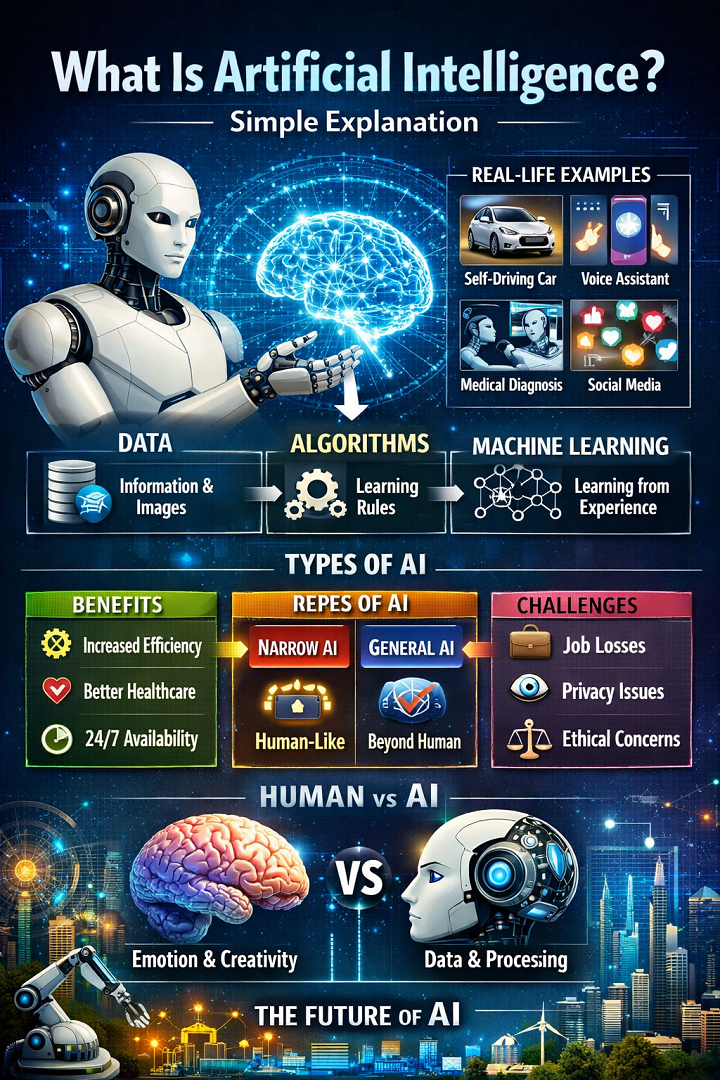
What Is Artificial Intelligence? Simple Explanation
Artificial Intelligence (AI) is one of the most talked-about technologies in the modern world. From smartphones and social media to healthcare and self-driving cars, AI is transforming how we live and work. But what exactly is Artificial Intelligence? And how does it work?
In this beginner-friendly guide, we will explain AI in simple terms, explore how it works, its types, real world examples, benefits, risks, and its future.
What Is Artificial Intelligence?
Artificial Intelligence, often called AI, refers to machines or computer systems that can perform tasks that usually require human intelligence.
In simple words:
AI is when a machine can think, learn, and make decisions like a human.
These tasks include:
- Understanding language
- Recognizing images
- Solving problems
- Making decisions
- Learning from experience
A Simple Example of AI
Think about when you use your smartphone:
- Voice assistants like Siri or Google Assistant understand your voice
- YouTube recommends videos you like
- Google Maps suggests the fastest route
All of these use AI.
How Does Artificial Intelligence Work?
AI works by combining large amounts of data with smart algorithms (rules or instructions).
Basic process:
- Data Collection
AI systems collect data (images, text, numbers). - Processing
The system analyzes the data using algorithms. - Learning
The AI learns patterns from the data. - Decision Making
It uses what it learned to make decisions or predictions.
What Is Machine Learning?
Machine Learning is a major part of AI.
Simple definition:
It is the ability of machines to learn from data without being explicitly programmed.
For example:
- Netflix recommends movies based on your watch history
- Email filters detect spam messages
The more data the system gets, the smarter it becomes.
Types of Artificial Intelligence
AI can be divided into different types based on its capabilities.
1. Narrow AI (Weak AI)
This is the most common type of AI today.
Features:
- Designed for specific tasks
- Cannot perform outside its function
Examples:
- Chatbots
- Recommendation systems
- Voice assistants
2. General AI (Strong AI)
This type of AI can perform any intellectual task like a human.
Status:
- Still under development
- Not fully achieved yet
3. Super AI
This is a future concept where AI becomes more intelligent than humans.
Reality:
- Theoretical
- Not yet developed
Real-Life Examples of AI
AI is already part of our daily lives.
1. Social Media
Platforms like Instagram and Facebook use AI to:
- Show relevant posts
- Recommend friends
- Detect harmful content
2. Online Shopping
E-commerce websites use AI to:
- Suggest products
- Analyze customer behavior
- Improve user experience
3. Healthcare
AI helps doctors by:
- Diagnosing diseases
- Analyzing medical images
- Predicting health risks
4. Banking and Finance
AI is used for:
- Fraud detection
- Credit scoring
- Automated trading
5. Transportation
AI powers:
- Self-driving cars
- Traffic prediction systems
- Navigation apps
Benefits of Artificial Intelligence
AI offers many advantages across industries.
1. Automation
AI can perform repetitive tasks automatically, saving time and effort.
2. Accuracy
AI reduces human errors and improves precision.
3. Speed
AI processes information much faster than humans.
4. 24/7 Availability
Machines can work continuously without breaks.
5. Better Decision Making
AI analyzes large data to provide smart insights.
Disadvantages of Artificial Intelligence
Despite its benefits, AI also has some drawbacks.
1. Job Displacement
Automation may replace some human jobs.
2. High Costs
Developing AI systems can be expensive.
3. Lack of Creativity
AI cannot think creatively like humans.
4. Dependence on Technology
Too much reliance on AI can reduce human skills.
5. Ethical Concerns
Issues like privacy, bias, and misuse of AI are important challenges.
AI vs Human Intelligence
| Feature | AI | Human |
|---|---|---|
| Speed | Very fast | Slower |
| Learning | Data-based | Experience-based |
| Creativity | Limited | High |
| Emotions | None | Strong |
| Accuracy | High | Can make mistakes |
Is AI Dangerous?
AI itself is not dangerous, but how it is used matters.
Risks include:
- Misuse of technology
- Privacy invasion
- Biased decision-making
Solution:
Proper regulations and ethical use of AI are necessary.
Future of Artificial Intelligence
AI is growing rapidly and will play a major role in the future.
Expected developments:
- Smarter virtual assistants
- Advanced healthcare solutions
- Fully autonomous vehicles
- AI-powered education
AI will likely become a part of every industry.
How to Learn Artificial Intelligence
If you are interested in AI, here’s how you can start:
1. Learn Basic Concepts
Understand:
- AI fundamentals
- Machine learning
- Data science
2. Learn Programming
Languages like:
- Python
- R
3. Practice Projects
Build small AI models or apps.
4. Take Online Courses
Many free and paid courses are available online.
Why AI Is Important
AI is important because it:
- Improves efficiency
- Solves complex problems
- Drives innovation
- Enhances daily life
From healthcare to education, AI is shaping the future.
Final Thoughts
Artificial Intelligence is not just a futuristic concept it is already part of our daily lives. It helps us make better decisions, saves time, and improves productivity. While it has some challenges, its benefits are far greater when used responsibly.
Understanding AI is becoming increasingly important in today’s digital world. Whether you are a student, professional, or business owner, learning about AI can open new opportunities.
Conclusion
So, what is Artificial Intelligence?
It is the ability of machines to think, learn, and act like humans. From simple tasks like recommendations to complex systems like self-driving cars, AI is transforming the world around us.
