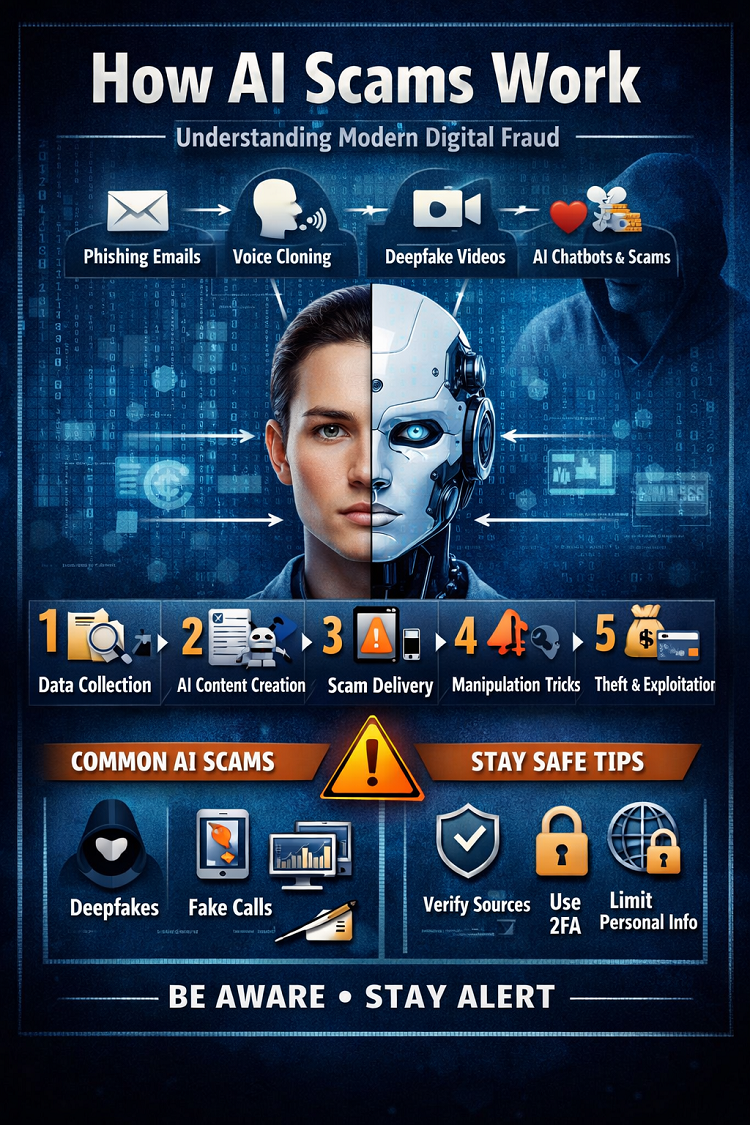
How AI Scams Work A Complete Guide to Understanding and Avoiding Modern Digital Fraud
Artificial Intelligence (AI) is transforming the world in incredible ways. From smart assistants and chatbots to automated customer service and personalized recommendations, AI has become a part of our daily lives. Companies like OpenAI, Google, and Microsoft are building powerful AI systems that improve productivity and innovation across industries.
However, like every powerful technology, AI can also be misused. Cybercriminals are now using AI to create smarter, faster, and more convincing scams than ever before. These scams are harder to detect and often look extremely real.
In this detailed guide, we will explore:
-
What AI scams are
-
How AI scams work step by step
-
The most common types of AI scams
-
Real-world examples
-
Why AI scams are increasing
-
How to protect yourself from AI-based fraud
Let’s dive deep into the world of AI scams.
What Are AI Scams?
AI scams are fraudulent schemes that use artificial intelligence tools to trick people into giving away money, personal information, or access to their accounts. These scams often involve:
-
Deepfake videos
-
AI-generated voices
-
Fake AI-written emails and messages
-
AI chatbots impersonating real people
-
Automated phishing attacks
Traditional scams required manual effort. Today, AI allows scammers to automate their operations, personalize attacks, and scale their efforts globally.
In simple words:
AI scams use smart machines to create smarter fraud.
Why AI Makes Scams More Dangerous
AI gives scammers several powerful advantages:
1. Realistic Content Creation
AI tools can generate:
-
Human-like text
-
Realistic voices
-
Fake videos that look authentic
-
Professional-looking documents
This makes scams more believable.
2. Automation at Scale
Scammers can send thousands or even millions of messages using AI automation. Instead of manually writing emails, AI tools generate personalized messages instantly.
3. Personalization
AI can analyze social media profiles, public records, and leaked data to create targeted scams. Victims receive messages that seem tailored specifically for them.
4. Speed
AI works 24/7. It can create and launch scam campaigns in minutes.
How AI Scams Work (Step-by-Step Breakdown)
Let’s understand the process behind AI scams.
Step 1: Data Collection
Before launching a scam, criminals gather information about potential victims. They collect data from:
-
Social media platforms
-
Public records
-
Data breaches
-
Leaked databases
-
Company websites
AI tools analyze this data to understand:
-
Your interests
-
Your job
-
Your friends and family
-
Your online behavior
This helps scammers design highly targeted attacks.
Step 2: AI Content Generation
Once the data is collected, AI tools generate scam material. This may include:
AI-Generated Emails
AI can write emails that:
-
Mimic official company language
-
Use correct grammar
-
Sound professional
-
Include personal details
These emails are often used in phishing attacks.
AI Voice Cloning
Voice cloning software can copy someone’s voice using just a few seconds of audio. Scammers may:
-
Call parents pretending to be their child
-
Impersonate CEOs to request urgent payments
-
Pretend to be bank officials
Deepfake Videos
Deepfake technology uses AI to create fake videos of real people speaking or doing things they never did.
Criminals may create:
-
Fake celebrity endorsements
-
Fake political announcements
-
Fake investment opportunities
Step 3: Delivery of the Scam
After generating scam content, criminals deliver it through:
-
Email
-
SMS (smishing)
-
Phone calls
-
Social media messages
-
Fake websites
-
Messaging apps
AI chatbots may even hold real-time conversations with victims.
Step 4: Manipulation and Psychological Tricks
AI scams rely heavily on psychology. They create urgency, fear, or excitement.
Common emotional triggers include:
-
“Your account will be suspended.”
-
“You’ve won a prize.”
-
“Your family member is in danger.”
-
“Limited-time investment opportunity.”
Because the content feels personal and realistic, victims are more likely to believe it.
Step 5: Theft or Exploitation
Once trust is established, scammers ask for:
-
Bank details
-
OTP codes
-
Passwords
-
Cryptocurrency transfers
-
Gift cards
-
Personal documents
After receiving the information or money, scammers disappear.
Common Types of AI Scams
Let’s explore the most common AI-powered fraud schemes.
1. AI Phishing Emails
AI writes professional, error-free emails that look exactly like messages from:
-
Banks
-
Delivery services
-
Government departments
-
Tech companies
Unlike older phishing emails with grammar mistakes, AI-generated messages are almost perfect.
2. Deepfake Video Scams
Deepfakes use AI to manipulate videos. Criminals have used deepfake videos to:
-
Impersonate CEOs
-
Create fake news clips
-
Promote fake investment platforms
In some cases, employees have transferred millions of dollars after seeing a fake video call from someone who looked like their company executive.
3. Voice Cloning Scams
Voice cloning is one of the fastest-growing AI scams.
Example scenario:
-
A scammer clones a child’s voice.
-
The parent receives a call.
-
The cloned voice says, “Mom, I’m in trouble. Send money urgently.”
Because the voice sounds real, many victims panic and send money immediately.
4. AI Investment Scams
AI is used to create fake trading platforms and investment apps. Scammers may claim their system uses:
-
Advanced AI trading bots
-
Automated stock predictions
-
Cryptocurrency algorithms
They promise guaranteed returns, but the platform is fake.
5. AI Chatbot Romance Scams
Romance scams are now powered by AI chatbots that:
-
Talk 24/7
-
Write romantic messages
-
Send realistic photos (AI-generated)
-
Build emotional connections
After gaining trust, they ask for money.
6. Fake Job Offer Scams
AI is used to create:
-
Fake job descriptions
-
Professional-looking offer letters
-
Realistic HR emails
Victims are asked to pay “training fees” or share sensitive documents.
Real-World Examples of AI Scams
AI scams are not theoretical — they are happening globally.
In several cases, companies have reported losing millions after deepfake video calls from fake executives. Cybercriminals have also used AI-generated political messages to influence public opinion.
Major technology companies, including Meta and Amazon, continuously warn users about AI-based fraud on their platforms.
Governments worldwide are now developing regulations to control AI misuse.
Why AI Scams Are Increasing
There are several reasons behind the rise of AI scams.
1. AI Tools Are Easily Available
Many AI tools are accessible online. Some are free or low-cost. Even non-technical criminals can use them.
2. Social Media Exposure
People share large amounts of personal information online, including:
-
Voice recordings
-
Videos
-
Photos
-
Location details
This makes it easier for scammers to create deepfakes or clone voices.
3. Global Connectivity
Scammers can target victims anywhere in the world.
4. Difficulty in Detection
AI-generated content is becoming harder to detect. Even experts sometimes struggle to differentiate real from fake.
Warning Signs of AI Scams
Here are some red flags:
-
Urgent requests for money
-
Pressure to act quickly
-
Requests for OTP codes
-
Suspicious links
-
Too-good-to-be-true investment offers
-
Emotional manipulation
-
Video or audio that feels slightly “off”
If something feels strange, it probably is.
How to Protect Yourself from AI Scams
Protection requires awareness and smart digital habits.
1. Verify Before Trusting
If you receive:
-
A suspicious call from a “family member”
-
A payment request from your boss
-
An urgent bank warning
Contact the person directly using official channels.
2. Use Two-Factor Authentication (2FA)
Enable 2FA on:
-
Email
-
Banking apps
-
Social media
-
Payment apps
This adds an extra layer of security.
3. Limit Personal Information Online
Avoid posting:
-
Full date of birth
-
Phone number
-
Home address
-
Private family details
The less information available, the harder it is for scammers.
4. Be Careful with Voice and Video Sharing
Since AI can clone voices, be mindful of:
-
Public voice recordings
-
Long video uploads
-
Personal live streams
5. Check URLs Carefully
Many AI phishing attacks use fake websites that look identical to real ones.
Always double-check:
-
Spelling
-
Domain names
-
HTTPS security
6. Use Trusted Security Software
Install reputable antivirus and security software to detect phishing attempts.
7. Stay Updated About New Scam Trends
AI scams evolve quickly. Regularly read updates from cybersecurity sources.
The Future of AI Scams
As AI technology becomes more advanced, scams may become:
-
More realistic
-
Fully automated
-
Harder to detect
-
More personalized
However, cybersecurity is also improving. AI is being used to fight AI scams through:
-
Deepfake detection tools
-
Fraud detection systems
-
AI-based security monitoring
Technology itself is not evil misuse is the problem.
Final Thoughts
AI is one of the most powerful technologies of our time. It is improving healthcare, education, finance, and business. But at the same time, it is being used by criminals to create smarter scams.
