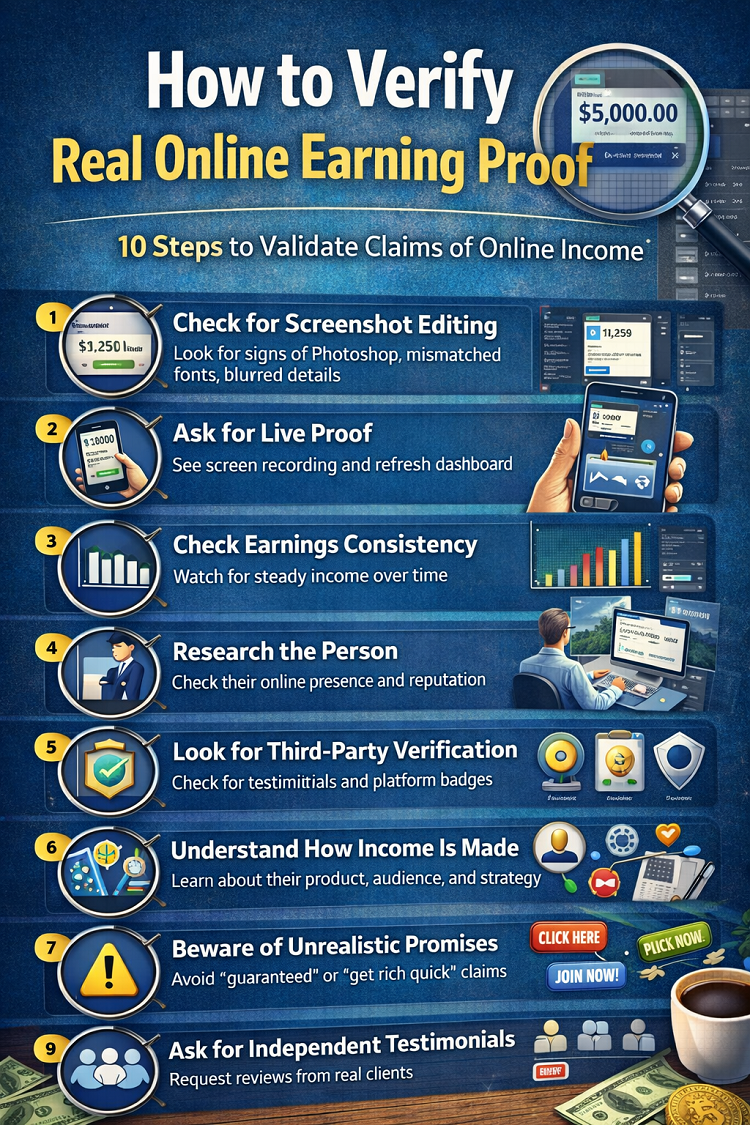
How to Verify Real Online Earning Proof
In today’s digital world, social media feeds, YouTube ads, Facebook groups, and freelance platforms are filled with screenshots of income dashboards, payment notifications, and “proof” of massive online earnings. From affiliate marketing and dropshipping to freelancing and crypto trading, people often showcase their income as a way to build trust, sell courses, or attract followers.
But here’s the truth: not all online earning proof is real.
Many fake screenshots are edited. Some dashboards are demo accounts. Others are temporary spikes that don’t represent consistent income. If you’re planning to invest time, money, or effort into an online opportunity, you must know how to verify real online earning proof properly.
This detailed guide will teach you how to identify authentic earning proof, spot fake screenshots, and protect yourself from scams.
Why Verifying Online Earning Proof Is Important
Before trusting anyone’s income claim, ask yourself: Why are they showing this proof?
Common reasons include:
-
Selling a course or mentorship
-
Promoting affiliate products
-
Attracting clients
-
Building authority
-
Recruiting people into a program
While many people are genuine, scammers use fake earning proof to create urgency and emotional pressure. If you fall for false claims, you may:
-
Lose money in fake courses
-
Join pyramid schemes
-
Waste time on unrealistic systems
-
Damage your trust in legitimate online work
That’s why verification is critical.
Types of Online Earning Proof People Show
Understanding the common formats helps you analyze them better.
1. Payment Screenshots
These include screenshots of:
-
PayPal payments
-
Payoneer balance
-
Bank deposits
-
Stripe dashboards
-
Crypto wallets
2. Dashboard Revenue Screens
Examples:
-
Affiliate marketing earnings
-
YouTube monetization revenue
-
Shopify sales dashboard
-
Amazon seller income
-
Freelance platform earnings
3. Withdrawal Confirmations
People show:
-
Bank SMS alerts
-
Withdrawal history
-
Payment confirmation emails
4. Video Screen Recordings
Some creators record their screen to show “live” proof.
Each type can be real — or manipulated.
Step 1: Check for Screenshot Editing Signs
Many fake proofs are edited using Photoshop or mobile apps.
Look for:
-
Blurry numbers
-
Mismatched fonts
-
Incorrect currency symbols
-
Cropped edges
-
Uneven alignment
-
Different font sizes
-
Unnatural shadows
Zoom in carefully. Fake screenshots often reveal editing errors around numbers.
If the image resolution is low or cropped tightly around the amount, that can also be suspicious.
Step 2: Ask for Live Proof
The most reliable proof is live demonstration.
If someone claims high income:
-
Ask them to show a live screen recording.
-
Request refresh of the dashboard.
-
Ask them to open transaction history.
-
Ask them to scroll.
Real earners usually don’t hesitate to show consistent income history (without revealing private data).
Scammers often avoid live proof and make excuses like:
-
“My account is private.”
-
“I don’t want to reveal secrets.”
-
“Just trust me.”
Step 3: Check Consistency of Earnings
One big payment does not mean stable income.
Verify:
-
Are the earnings consistent over months?
-
Is there daily or weekly activity?
-
Does the income history show realistic growth?
Many scammers show a single large earning screenshot but hide zero earnings before or after.
Consistency is more important than one big number.
Step 4: Research the Person’s Online Presence
Search their name on:
-
Google
-
LinkedIn
-
Instagram
-
YouTube
-
Facebook
Ask:
-
Do they have a long-term presence?
-
Do they provide free value content?
-
Do others vouch for them?
-
Are there negative reviews?
Real professionals usually have digital footprints. Scammers often create new profiles with fake followers.
Step 5: Look for Third-Party Verification
The most trustworthy proof includes:
-
Verified testimonials
-
Public case studies
-
Platform badges (Top Rated on Upwork, Verified Seller on Amazon)
-
Public affiliate rankings
If earnings come from freelance platforms, check if their profile is public and shows reviews.
If earnings come from YouTube, check their channel views and engagement.
If someone claims Shopify sales, ask if the store is publicly accessible.
Step 6: Understand the Business Model
If you don’t understand how the income is generated, it’s easier to be fooled.
Ask:
-
What product or service is being sold?
-
Who is the target audience?
-
Where does traffic come from?
-
What is the conversion strategy?
If someone cannot clearly explain their business model, that’s a red flag.
Real earners can clearly describe:
-
Their niche
-
Their process
-
Their strategy
-
Their timeline
Scammers usually give vague answers like:
“Just follow my system.”
Step 7: Beware of Unrealistic Claims
Red flags include:
-
“Earn $5,000 in 7 days with no work.”
-
“100% guaranteed income.”
-
“Zero investment, unlimited returns.”
-
“Secret method no one knows.”
Real online earning requires:
-
Skills
-
Time
-
Testing
-
Learning
-
Patience
If it sounds too easy, it probably is fake.
Step 8: Verify Payment Notifications Carefully
SMS alerts and email confirmations can be easily faked.
Anyone can:
-
Edit an email template
-
Use HTML to fake payment notifications
-
Create demo dashboards
-
Send fake SMS using apps
If someone shows a PayPal or Payoneer screenshot:
-
Check if transaction ID looks real
-
Look for correct formatting
-
Verify date consistency
-
Confirm currency formatting
Remember: Images alone are not proof.
Step 9: Analyze Engagement vs Claimed Income
If someone claims $50,000 per month but:
-
Has 200 Instagram followers
-
Has low YouTube views
-
Has no client reviews
This creates doubt.
While some earn quietly, extreme mismatch between audience size and claimed income can signal exaggeration.
Step 10: Ask for Independent Testimonials
Instead of screenshots, ask for:
-
Real client reviews
-
Video testimonials
-
Independent verification
-
Public references
Better yet, contact their past clients directly if possible.
Common Scams Using Fake Earning Proof
1. Course Selling Scams
Fake income screenshots used to sell expensive courses.
2. Forex & Crypto Signal Groups
Showing fake trading profits to attract subscribers.
3. MLM & Pyramid Schemes
Displaying one member’s income to recruit others.
4. Dropshipping Gurus
Showing Shopify revenue without showing profit margins.
Revenue is not profit — many fake gurus hide expenses.
How to Protect Yourself
Here are smart protection strategies:
-
Never invest immediately.
-
Take time to research.
-
Avoid emotional decisions.
-
Don’t trust edited images.
-
Avoid pressure tactics.
-
Verify through multiple sources.
If someone pushes urgency like:
“Offer ends today!”
“Only 5 spots left!”
“Join now or miss out!”
Pause and think carefully.
Real Signs of Genuine Online Earners
Authentic online earners usually:
-
Share both wins and struggles.
-
Talk about failures.
-
Explain their journey honestly.
-
Provide free educational value.
-
Do not guarantee unrealistic results.
-
Focus on skills, not shortcuts.
They build trust gradually — not through flashy screenshots.
Final Thoughts
The online earning world is full of opportunities — but also full of deception. Screenshots alone do not equal truth. Income proof can be edited, staged, or exaggerated.
Learning how to verify real online earning proof protects your money, time, and confidence.
Always remember:
-
Real success takes time.
-
Real income requires effort.
-
Real proof shows consistency.
-
Real professionals are transparent.
Before trusting any earning claim, apply the steps in this guide. Ask questions. Analyze details. Verify independently.
