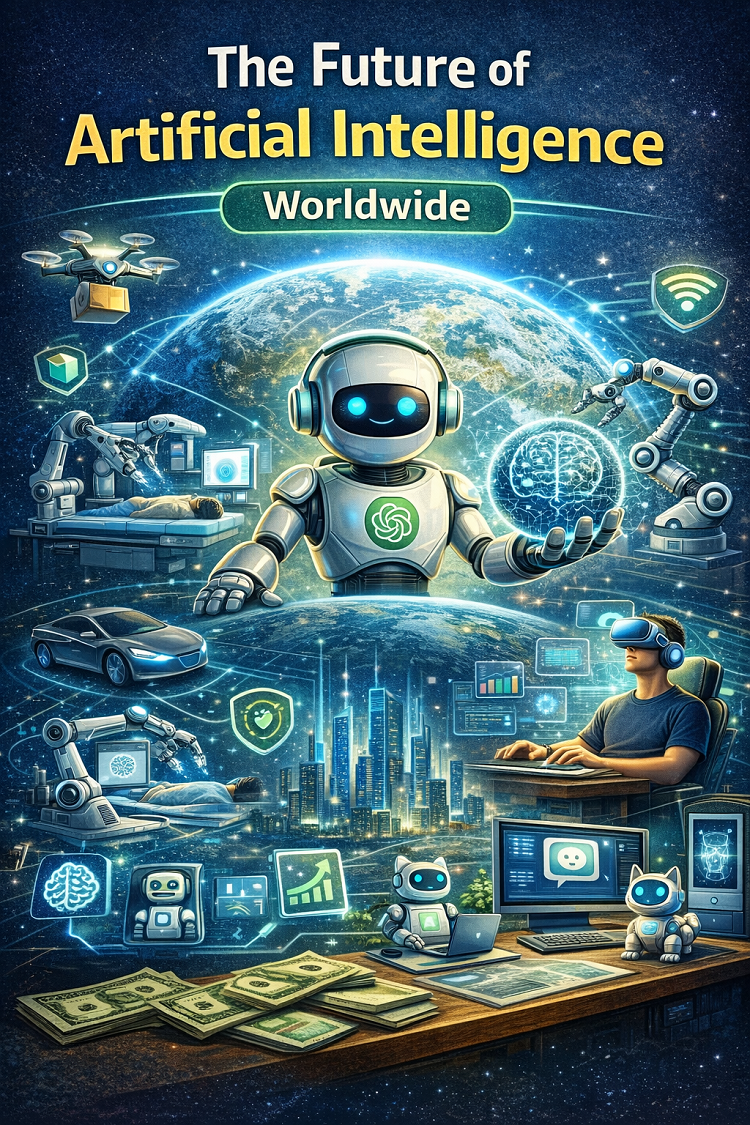
The Future of Artificial Intelligence Worldwide
Artificial intelligence (AI) is no longer confined to research labs or science fiction. It is embedded in everyday life from voice assistants and recommendation systems to medical diagnostics and financial forecasting. As AI technologies continue to advance, they are reshaping industries, economies, and societies on a global scale.
The future of artificial intelligence worldwide is not just about smarter machines. It is about how humanity integrates AI into governance, education, healthcare, labor markets, and ethical frameworks. The coming decades will define how AI influences human progress, prosperity, and responsibility.
This article explores the global future of AI in depth: its economic impact, emerging technologies, ethical challenges, workforce transformation, international competition, and the path toward responsible innovation.
AI as a Global Economic Engine
Artificial intelligence is becoming one of the strongest drivers of economic growth worldwide.
Productivity and Automation
AI systems can process massive amounts of data faster than humans, enabling:
-
Automated manufacturing
-
Smart logistics and supply chains
-
Predictive maintenance
-
Financial analytics
-
Customer service automation
These efficiencies reduce operational costs and increase productivity, helping businesses scale faster than ever before.
New Industries and Markets
AI is not only optimizing existing industries it is creating entirely new ones:
-
Autonomous transportation
-
AI-driven biotechnology
-
Smart cities infrastructure
-
Advanced robotics
-
Personalized digital services
Countries that invest early in AI research and infrastructure are positioning themselves as leaders in the next economic era.
AI in Healthcare: A Global Transformation
Healthcare is one of the sectors where AI’s future impact is most profound.
Early Disease Detection
AI can analyze medical images and patient data to detect diseases such as cancer, heart conditions, and neurological disorders earlier than traditional methods.
Personalized Medicine
Machine learning allows doctors to tailor treatments to individual genetic profiles, improving outcomes and reducing side effects.
Global Healthcare Access
AI-powered telemedicine and diagnostic tools can extend quality healthcare to underserved regions, bridging global inequality.
The future promises healthcare systems that are more preventive, predictive, and personalized.
Education in the Age of AI
Artificial intelligence is reshaping how people learn worldwide.
Personalized Learning Systems
AI can adapt lessons to each student’s pace and learning style, providing:
-
Custom study plans
-
Instant feedback
-
Intelligent tutoring
-
Skill tracking
This approach may reduce educational gaps and improve retention.
Global Knowledge Access
AI-powered translation and digital platforms make education accessible across language barriers, expanding opportunities for millions.
The classroom of the future is likely to be hybrid — combining human teachers with AI assistants.
The Workforce Revolution
AI is changing the global labor market, but not in the simple way many fear.
Job Displacement vs Job Creation
While automation may replace repetitive tasks, AI also creates new careers:
-
AI system design
-
Data science
-
Robotics engineering
-
AI ethics consulting
-
Human-AI interaction design
Historically, technological revolutions have shifted work rather than eliminated it. The AI era is expected to follow the same pattern.
The Rise of Hybrid Jobs
Future roles will combine human judgment with AI tools. Workers who learn to collaborate with AI will outperform those who resist it.
Continuous reskilling will become a normal part of professional life.
AI and Global Competition
Artificial intelligence has become a strategic priority for nations.
Technological Leadership
Countries are investing heavily in:
-
AI research centers
-
Semiconductor manufacturing
-
Data infrastructure
-
Education and workforce training
Global leadership in AI influences economic power, military capability, and geopolitical influence.
International Collaboration
Despite competition, global cooperation is necessary to manage AI risks and standards. Shared research on safety, ethics, and regulation benefits all nations.
The future will likely involve both rivalry and collaboration.
Ethical Challenges of Advanced AI
The growth of AI raises serious ethical questions.
Bias and Fairness
AI systems trained on biased data can reinforce inequality. Ensuring fairness requires diverse datasets and transparent design.
Privacy and Surveillance
AI enables powerful data tracking capabilities. Societies must balance innovation with civil liberties.
Autonomous Decision-Making
As AI systems gain more autonomy, accountability becomes complex. Who is responsible when an AI makes a harmful decision?
Existential Concerns
Some experts warn about long-term risks of superintelligent AI systems. While debated, this discussion is shaping global research priorities in AI safety.
Ethical governance will be as important as technical progress.
AI and Environmental Sustainability
AI has the potential to fight climate change and environmental degradation.
Smart Energy Management
AI optimizes power grids, renewable energy distribution, and energy efficiency.
Climate Modeling
Advanced simulations help scientists predict climate patterns and plan mitigation strategies.
Sustainable Agriculture
AI-powered precision farming reduces waste and increases food production.
However, AI itself consumes energy. Balancing technological growth with sustainability will be a key challenge.
The Rise of Human-AI Collaboration
The future is not about humans versus machines. It is about partnership.
AI excels at:
-
Pattern recognition
-
Data processing
-
Repetitive tasks
Humans excel at:
-
Creativity
-
empathy
-
moral judgment
-
leadership
-
cultural understanding
The most successful societies will design systems that combine both strengths.
Regulation and Global Governance
AI’s power demands global governance frameworks.
Responsible Regulation
Governments worldwide are developing laws addressing:
-
Data protection
-
AI transparency
-
safety standards
-
ethical compliance
-
labor protections
Good regulation encourages innovation while protecting citizens.
Global Standards
International cooperation may lead to shared AI guidelines similar to environmental or nuclear agreements.
The challenge is regulating without stifling progress.
The Democratization of AI
AI tools are becoming accessible to individuals, not just corporations.
Small businesses, students, and independent creators now use AI to:
-
Build applications
-
Create art and media
-
Conduct research
-
Launch startups
This democratization spreads opportunity globally.
The next wave of innovation may come from unexpected places.
Risks of Inequality
While AI can empower many, it can also concentrate wealth and power.
Nations and corporations with advanced AI infrastructure may dominate markets. Without inclusive policies, the gap between technological leaders and followers could widen.
Education and global access initiatives are critical to prevent digital inequality.
Preparing Humanity for the AI Future
The future of AI depends on preparation.
Key priorities include:
-
AI literacy in education
-
Workforce reskilling programs
-
Ethical design training
-
Global research collaboration
-
Inclusive economic policies
Societies that invest in human adaptation will benefit most.
Long-Term Vision: Beyond Automation
Looking further ahead, AI may transform civilization in ways comparable to the Industrial Revolution.
Possible futures include:
-
Fully autonomous transportation systems
-
AI-assisted scientific discovery
-
Extended human lifespan through medical AI
-
Global digital governance systems
-
Brain-computer interfaces
While speculative, rapid progress suggests dramatic change within decades.
Final Thoughts
The future of artificial intelligence worldwide is not predetermined. It will be shaped by choices made by governments, companies, educators, and individuals.
AI can increase prosperity, cure diseases, reduce inequality, and accelerate human knowledge. It can also create risks if mismanaged. The outcome depends on responsibility, cooperation, and foresight.
