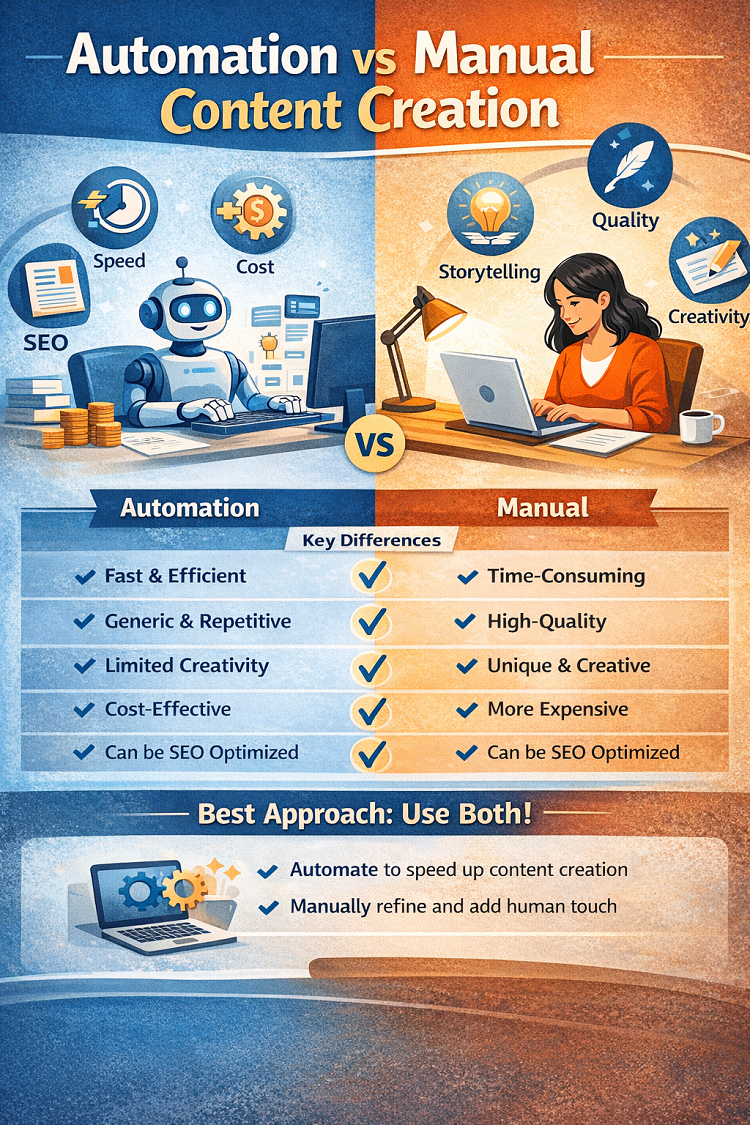
Automation vs Manual Content Creation A Complete In-Depth Guide
Content creation is the backbone of digital marketing, blogging, and online businesses. Whether you are running a website, YouTube channel, or social media page, content is what attracts, engages, and converts your audience. However, with the rise of advanced tools and artificial intelligence, a major debate has emerged: Automation vs Manual Content Creation.
Which method is better? Should you rely on automation tools or stick to traditional manual writing? In this detailed guide, we will explore both approaches, compare their advantages and disadvantages, and help you decide which one suits your needs.
What is Manual Content Creation?
Manual content creation refers to the traditional process where a human writer creates content from scratch. This involves:
- Researching the topic
- Planning the structure
- Writing the content
- Editing and proofreading
It requires time, effort, and creativity, but it also allows for deeper control and personalization.
What is Automated Content Creation?
Automated content creation uses tools, software, or AI to generate content quickly. These tools can:
- Generate articles
- Suggest ideas
- Rewrite content
- Optimize for SEO
Automation can significantly speed up the content creation process and reduce workload.
🔹 Comparison Table
| Feature | Automation Content Creation | Manual Content Creation |
|---|---|---|
| Speed | Very Fast | Slow |
| Cost | Low | High |
| Quality | متوسط (Medium) | High |
| Creativity | Limited | High |
| SEO Optimization | Good | Excellent |
| Scalability | High | Limited |
Key Differences Between Automation and Manual Content Creation
1. Speed
- Automation: Extremely fast. Content can be generated in minutes.
- Manual: Time-consuming. Writing high-quality content may take hours or even days.
👉 Automation clearly wins in speed.
2. Quality
- Manual: High-quality, original, and emotionally engaging.
- Automation: Can be good, but sometimes lacks depth, creativity, or human touch.
👉 Manual writing usually produces better quality.
3. Creativity
- Manual: Writers can express emotions, storytelling, and unique ideas.
- Automation: Limited creativity, often based on patterns and data.
👉 Manual content is more creative and engaging.
4. Cost
- Automation: Low cost (tools are cheaper than hiring writers).
- Manual: Can be expensive if you hire professionals.
👉 Automation is more budget-friendly.
5. SEO Performance
- Automation: Can generate SEO-optimized content quickly.
- Manual: Better understanding of user intent and audience needs.
👉 Both can perform well if used correctly.
Advantages of Manual Content Creation
1. Human Touch
Manual content feels natural, relatable, and emotionally engaging.
2. Better Storytelling
Writers can create compelling stories that connect with readers.
3. Higher Credibility
Human-written content often appears more trustworthy and authentic.
4. Flexibility
Writers can adapt tone, style, and message based on the audience.
Disadvantages of Manual Content Creation
- Time-consuming
- Expensive
- Requires skill and experience
- Hard to scale for large projects
Advantages of Automated Content Creation
1. Speed and Efficiency
Automation tools can create large amounts of content quickly.
2. Cost-Effective
You can save money compared to hiring multiple writers.
3. Consistency
Maintains a consistent tone and style across content.
4. Scalability
Ideal for businesses that need bulk content.
Disadvantages of Automated Content Creation
- Lack of creativity
- May produce generic or repetitive content
- Risk of inaccuracies
- Less emotional connection
When Should You Use Manual Content Creation?
Manual writing is best when:
- You need high-quality blog posts
- You want strong storytelling
- You are building a brand
- You need expert-level content
For example, personal blogs, brand storytelling, and thought leadership content should always be written manually.
When Should You Use Automated Content Creation?
Automation is useful when:
- You need bulk content quickly
- You are managing multiple websites
- You need product descriptions
- You want to generate ideas or outlines
It is especially helpful for startups and businesses with limited budgets.
Hybrid Approach: The Best of Both Worlds
The smartest strategy is to combine both methods.
How it works:
- Use automation tools to generate ideas or drafts
- Edit and improve the content manually
- Add creativity, personality, and accuracy
This approach saves time while maintaining quality.
Real-Life Use Cases
1. Blogging
- Use automation for outlines
- Write content manually for better engagement
2. E-commerce
- Use automation for product descriptions
- Manually refine important pages
3. Social Media
- Use automation for captions and scheduling
- Add human creativity for viral posts
Common Mistakes to Avoid
1. Relying Only on Automation
This can lead to low-quality, generic content.
2. Ignoring Editing
Even automated content needs human review.
3. Not Understanding Your Audience
Automation cannot fully understand your audience’s emotions.
4. Overusing Keywords
Both methods should avoid keyword stuffing.
Future of Content Creation
The future lies in collaboration between humans and machines. Automation tools will continue to improve, but human creativity will always remain valuable.
Content creators who learn how to use automation effectively while maintaining quality will have a strong advantage in the digital world.
🔹 Best Use Cases Table
| Use Case | Best Method |
|---|---|
| Blog Articles | Manual |
| Product Descriptions | Automation |
| SEO Content | Both |
| Social Media Posts | Both |
| Branding Content | Manual |
Which One Should You Choose?
Here is a simple guideline:
- Choose manual content creation for quality, branding, and storytelling
- Choose automation for speed, volume, and cost-saving
- Use a hybrid approach for the best results
Final Thoughts
Automation vs manual content creation is not about choosing one over the other it’s about using both wisely. Automation helps you work faster, while manual writing ensures quality and emotional connection.
If you want to succeed in content creation, focus on learning both methods and combining them effectively. This will help you produce high-quality content at scale and maximize your earning potential.
